
Living Curriculum Online
Develop your faculty. Strengthen your school. Retain your teachers.
Is there a gap between your mission and your process when it comes to faculty development and evaluation?
Christian school leaders carry a unique responsibility. You are stewarding the teachers who disciple, challenge, and shape your students every single day. But many Christian schools struggle to build consistent processes that support the professional growth of their teachers and give them reasons to stay.
Does any of this sound familiar?
- You have a clear mission and high standards for teaching, but your evaluation process doesn’t reflect either.
- Your feedback to teachers is inconsistent, not because you don’t care, but because there’s not criteria or a structure to make it regular and meaningful.
- You find it difficult to set clear vision and direction around expectations for new teachers.
- You’ve lost good teachers and told yourself it was about pay. But you wonder if they left because they didn’t feel seen, developed, or invested in.
- You want to reward your best teachers, but without clearly documented criteria for what excellent teaching looks like, compensation decisions feel subjective.
A Platform Built by Christian Educators,
for Christian educators
Living Curriculum Online takes its name from Luke 6:40: “Everyone who is fully trained will be like their teacher.” Your teachers are the living curriculum. How you develop them shapes what your students become.
This platform was developed by the academic leadership team at Wheaton Academy, a nationally recognized Blue Ribbon school in the Chicago area, and refined through nearly two decades of real classroom observation and faculty development.
Unlike expensive compliance-based platforms built by software companies for public schools, Living Curriculum Online was built for a private Christian school context. It is fully adaptable to your school’s criteria and culture. The platform scales to your staff: a single administrator can run the entire process, or responsibilities can be distributed across a leadership team. Schools that implement our platform also receive Wheaton Academy’s full library of evaluation criteria, observation forms, and portfolio templates as a starting point, but every element can be customized to reflect your school’s unique standards and values.
Everything you need, in one place
Goal Setting
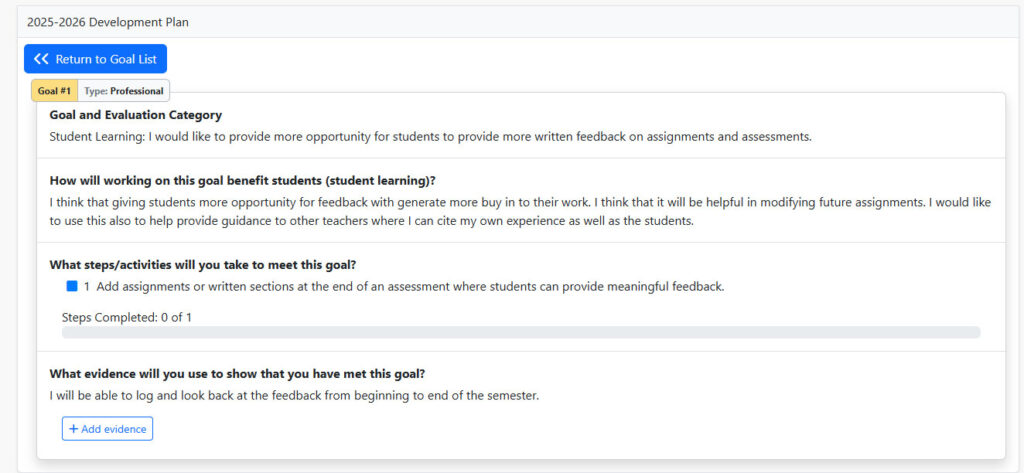
Teachers set meaningful, measurable goals at the start of each year, connected to your school’s mission and standards. Administrators can view and track progress throughout the year, and goals can carry forward across multiple years.
Classroom Observations
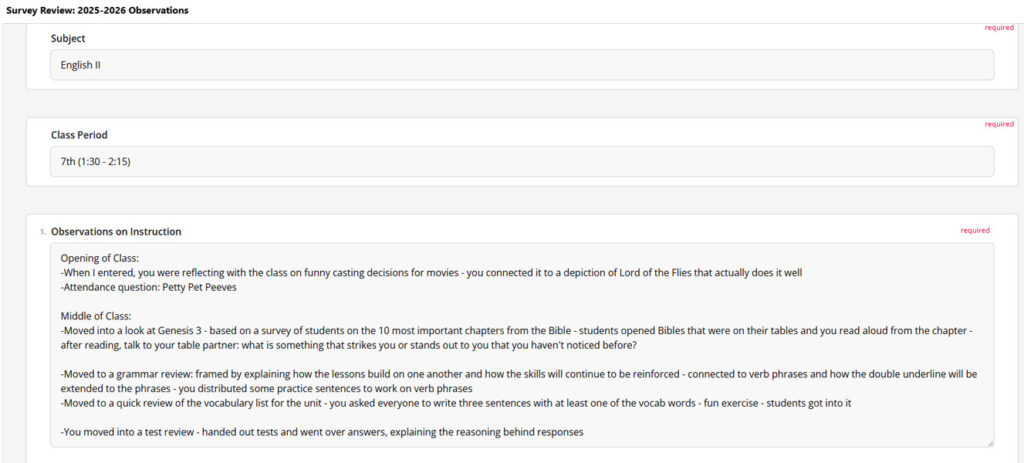
Administrators, department heads, and instructional coaches can each conduct observations using customizable forms tailored to their role. Completed observations are stored on the platform and released to teachers at the administrator’s discretion.
Student Surveys
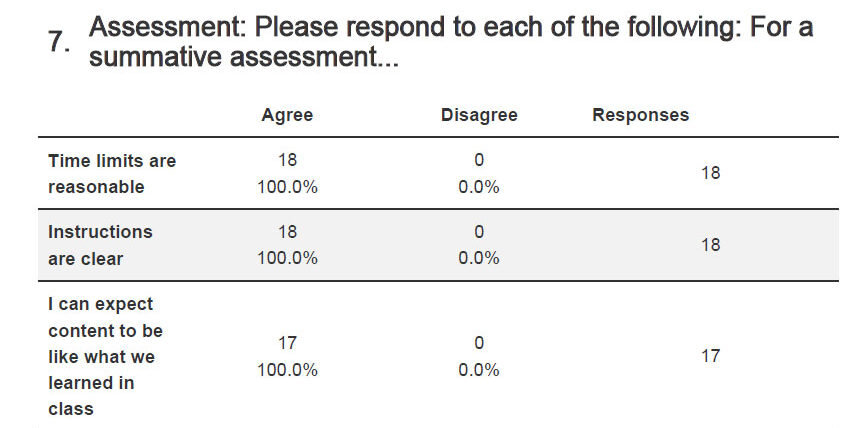
Each teacher has a personalized survey link that captures student feedback and stores results directly on the platform.
Self-Evaluation and Administrator Evaluation
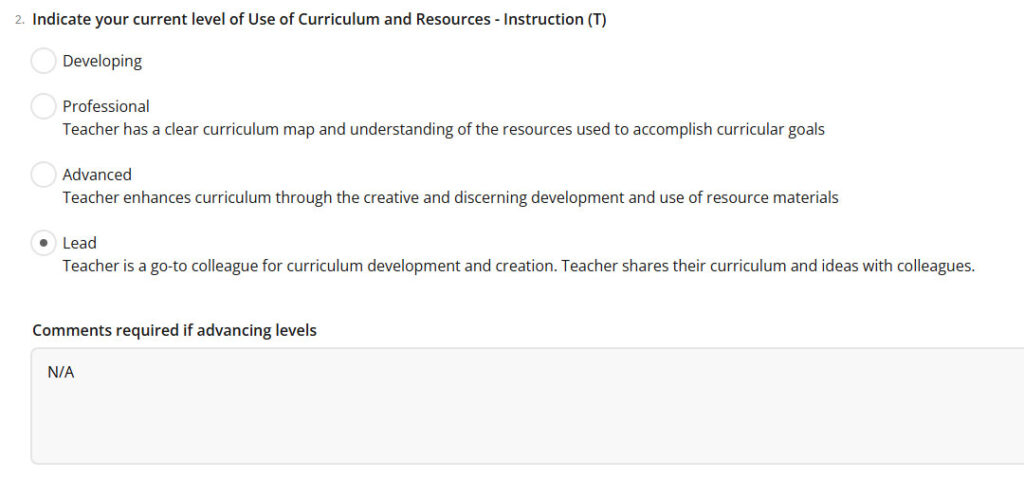
Teachers self-evaluate against the same criteria administrators use, creating a shared language for evaluation meetings.
Controlled Release
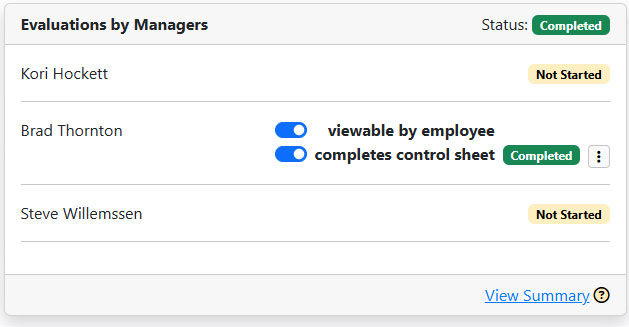
You control what teachers see and when. Observations, evaluations, narratives, and survey results are only visible to teachers when you choose to release them, giving your leadership team the space to review, discuss, and prepare before any feedback conversation takes place.
Narratives and Portfolios
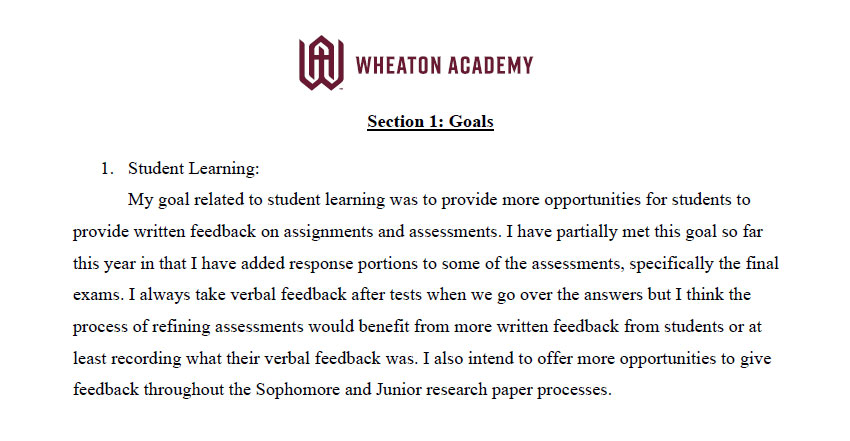
Teachers submit an end-of-year portfolio documenting their growth, goals, and professional development. Administrators write a narrative evaluation that synthesizes everything observed throughout the year into a meaningful, documented summary.
Evaluation Matrix
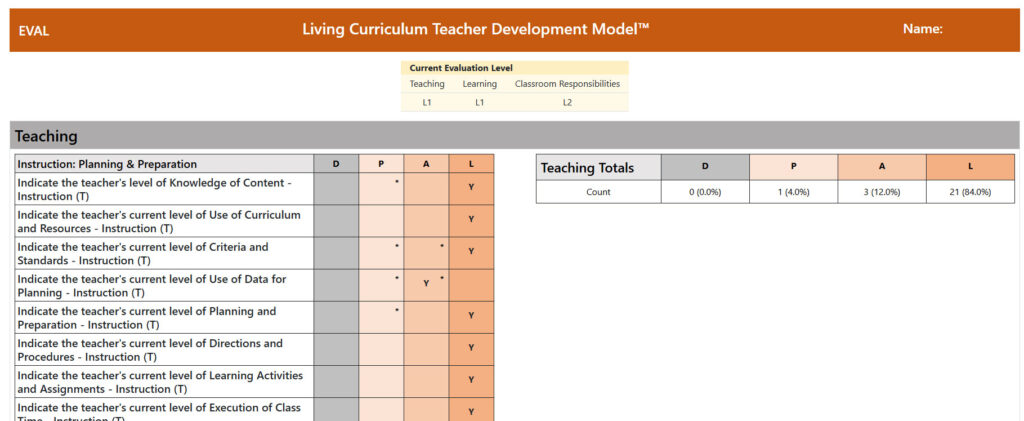
A structured rubric calculates each teacher’s overall teaching level based on administrator evaluations across multiple domains. For schools that choose to use it, teaching levels can connect directly to a performance-based compensation model.
Multi-Year Records
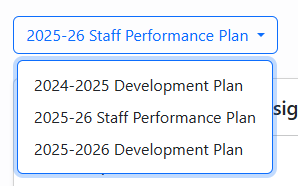
Every goal, observation, evaluation, and narrative is stored and accessible year over year. Administrators can track growth across time, pull records for accreditation, and build a complete picture of each teacher’s development journey. These comprehensive records also serve as an ongoing HR file, built through normal practice rather than assembled in a moment of crisis.
Goal Setting
Teachers set meaningful, measurable goals at the start of each year, connected to your school’s mission and standards. Administrators can view and track progress throughout the year, and goals can carry forward across multiple years.
Classroom Observation
Administrators, department heads, and instructional coaches can each conduct observations using customizable forms tailored to their role. Completed observations are stored on the platform and released to teachers at the administrator’s discretion.
Student Surveys
Each teacher has a personalized survey link that captures student feedback and stores results directly on the platform.
Self-Evaluation and Administrator Evaluation
Teachers self-evaluate against the same criteria administrators use, creating a shared language for evaluation meetings.
Controlled Release
You control what teachers see and when. Observations, evaluations, narratives, and survey results are only visible to teachers when you choose to release them, giving your leadership team the space to review, discuss, and prepare before any feedback conversation takes place.
Narratives and Portfolio
Teachers submit an end-of-year portfolio documenting their growth, goals, and professional development. Administrators write a narrative evaluation that synthesizes everything observed throughout the year into a meaningful, documented summary.
Evaluation Matrix
A structured rubric calculates each teacher’s overall teaching level based on administrator evaluations across multiple domains. For schools that choose to use it, teaching levels can connect directly to a performance-based compensation model.
Multi-Year Records
Every goal, observation, evaluation, and narrative is stored and accessible year over year. Administrators can track growth across time, pull records for accreditation, and build a complete picture of each teacher’s development journey. These comprehensive records also serve as an ongoing HR file, built through normal practice rather than assembled in a moment of crisis.
A tool born out of necessity
Several years ago, Wheaton Academy, a private Christian high school in the western suburbs of Chicago, took a hard look at how teachers were being compensated. At the time it was the typical model of years of experience + education. Not unlike school districts across the nation, they came to realize this model was broken. So they began development of a new process based on teacher performance and student growth. The simple metrics of experience and education on the sideline, new methods had to be developed to accurately assess how well teachers were doing. The result of this effort is the Living Curriculum Teacher Development Model (LCTDM™), with its focus on classroom observations, student surveys, goal-setting, and collaboration to foster growth and provide a framework for compensation.
The Online Application
Though it started out a paper system, the process was converted to an online software application, Living Curriculum Online. This Web application is the Swiss Army knife of LCTDM™, giving administrators and teachers ready access to the tools to streamline and automate the process. The entire application was built to be completely customizable so that users can tailor the content to fit their school’s culture and goals.
improving and growing
The Living Curriculum Teacher™ model provides tools that allow you to incorporate self-evaluation, goal setting, classroom observations, student/parent surveys, teacher portfolios, learning management, and collaborative discussions into the performance management process, fostering growth in your teachers and providing a framework for rewarding compensation.
A different model
The traditional approach to teacher evaluation and compensation has been based on the number of years in the classroom, the number of degrees, and the results of standardized testing. In recent years, administrators of Christian schools are realizing that it takes more to develop teachers that have a lasting impact on students.
While the education and experience of the teacher is important, leaders (evaluators) must encourage the continuing development of skills, methods, AND involvement in the life of the student and the school as disciples. This is the value of Christian education that our parents and students deserve.
The Living Curriculum Teacher™ is a performance management, learning management, and pay-for-performance model built to advance Christian education. The model focuses on three components of performance management – leadership, process and tools. The model assists leaders to motivate, develop, encourage, and compensate teachers using a realistic and personal approach of self-evaluation, goal setting, observation, learning management and evaluation, with feedback and collaboration.
First, we work to equip school leaders to create a culture of teamwork between administrators and teachers in an annual cycle of feedback and coaching. We believe this begins with a well-articulated learning philosophy, continues with clear performance criteria that leaders are aligned around and a strong evaluation process that leaders are invested in, and finishes with an understanding of what is good and what is great. When done well, the impact on student learning and individual transformation is significant. To assist schools with the leadership and process components, we offer Best Practice Intensives, in-house workshops, and consulting engagements to prepare and assist schools and school leaders in implementing the Living Curriculum Teacher™ model. Visit our pages on Educational Leadership & Teacher Development to learn more about how we can work with you to align your leadership, define your criteria, and determine your process.
what is Living Curriculum online?
Living Curriculum Online™ is a cloud-based application, accessible anytime and anywhere on any device to manage the process and documentation of your performance and learning management system. It allows individual schools and users, protected by unique IDs, to record and save data in an easily retrievable way.
Customizable
Customizable
Assessment hierarchy
Assessment hierarchy
Intentional evaluation
Intentional evaluation
Biblically Rooted
Luke 6:40 tells us that students become like the teachers who train them. That’s why it’s so important that one hundred percent of Christian educators are empowered to speak Biblical truth to every student and to model a life of commitment to Christ!
Their example is the “living curriculum.”
what makes living curriculum teachers℠ different?
Living Curriculum Teachers℠ understand that students flourish when they have opportunity to participate in a classroom where there is engaging instruction, compelling content, and different opportunities for students to express what they know.
Living Curriculum Teachers℠ know that, in the 21st century, learning goes beyond the memorization of facts; instead, our teachers challenge students to solve real-world problems and practically apply what they have learned with experiential learning opportunities.
Living Curriculum Teachers℠ invest in students’ character and learning habits. This intentional investment ensures that students will not only have the knowledge, but also the character traits and skills necessary to be successful in life after high school.
what educators have to say
“Being a Living Curriculum
teacher requires having
clear expectations and then reaching goals. I appreciate the way the Living Curriculum Teacher model helps me frame conversations and understand how to continue to grow year to year.”
New Teacher, Wheaton Academy
“I have always really appreciated this tool as a
way to improve my own teaching, and how that
then translates to learning. It allows me to set clear goals each year because of the specificity of the tool itself. Coming from someone who is
extremely goal oriented, this works well for me.”
experienced teacher, wheaton academy
“Wheaton Academy’s Living Curriculum Teacher model has been formative in helping me grow as a teacher. If you want to develop your craft of teaching, this model provides clear working targets to help achieve your professional goals and to enrich student learning.”
Experienced Teacher, Wheaton Academy
Frequently Asked Questions
Can we use our own evaluation forms and criteria, or do we have to use Wheaton Academy's?
Living Curriculum Online is fully adaptable. Every school that implements the platform receives Wheaton Academy’s complete library of evaluation criteria, observation forms, and portfolio templates as a starting point. You can use them as-is, modify them to fit your context, or build something entirely your own. The platform is designed to reflect your school’s standards and culture, not ours.
Can more than one administrator observe and evaluate the same teacher?
Yes. Multiple administrators can observe the same teacher, and all observations are stored on the platform. When it comes to the final evaluation, administrators can designate which evaluation feeds into the official record, giving you flexibility in how your leadership team divides responsibilities.
When do teachers see their evaluations and observations?
Administrators control when observations, evaluations, narratives, and survey results are released to teachers. Nothing is visible to a teacher until you choose to make it available, giving your leadership team the space to review, discuss, and prepare before any feedback conversation takes place.
Can the platform accommodate multiple schools or divisions within one institution?
Yes. If your institution includes multiple schools or divisions, separate performance plans can be set up for each, with different forms, criteria, and observation tools tailored to each context.
Is there a way to export or print records for personnel files or accreditation?
Yes. The platform includes a combined document view that compiles a teacher’s full record, including evaluations, observations, narratives, and portfolio materials, into a single exportable document. All records are also stored securely on the platform and accessible year over year.
What kind of ongoing support is available after implementation?
Platform support (included): Our coordinator, Jenn Trott, remains available to answer questions, troubleshoot technical issues, and help you navigate the platform as your needs evolve.
Consulting services (available separately for a fee): For schools that want to go deeper into building healthy culture and structures, Kori Hockett, Wheaton Academy’s Chief Academic Officer, offers consulting services tailored to your school’s needs.
Can we roll out the platform incrementally rather than all at once?
Absolutely. Some schools choose to implement all features in their first year, while others start with goal setting and observations before introducing self-evaluation and portfolios in subsequent years. We’ll work with you to find an approach that fits your school’s pace and culture.
Does Living Curriculum Online support performance-based compensation?
Living Curriculum Online includes an evaluation matrix that calculates teaching levels based on administrator evaluations across multiple domains. For schools that want to connect those teaching levels to a performance-based compensation model, that conversation starts with a call with our team.
Because compensation structures vary significantly from school to school, we don’t offer a one-size-fits-all solution. Instead, we work directly with your leadership team to understand your goals and help you think through how to configure a compensation model that fits your school’s context and values.
Program Distinctives
Living curriculum™ online features
- A thorough criteria for teacher evaluations in the following areas:
- Instruction
- Assessments
- Planning and Preparation
- Learning Environment
- Professional Responsibilities
- Community Relations &
- Spiritual Formation
- A teacher goal-setting component
- A template for narrative assessments
- A template for classroom observations
- Teacher access to evaluation materials
- Serves as a teacher learning management system with the ability to push out custom create or push out development curriculum
- Establishes the criteria and categorization for providing pay-for-performance
Online application:
- Branded to your school
- Accessible anytime, anywhere
- All content is customizable
- Data can be archived and retrieved from school year to school year
- Unique school and user IDs keep data separate, confidential, and secure
- System back-ups and redundancy ensure maximum safety and up-time
become a Living curriculum online School today
The best way to understand what Living Curriculum Online can do for your school is to see it firsthand. A demo takes about 45 minutes and gives you a chance to ask questions, explore the platform, and think through how it might fit your context.